Thứ Tư, 24 tháng 12, 2014

Vietnamese wedding ceremony

Depending on habits of specific ethnic groups, marriage includes various steps and related procedures, but in general, there are two main ceremonies:

Le an hoi (betrothal ceremony):

Normally, both bride and groom or their parents go to the fortuneteller to see what date and time is best for them. They strongly believe in this date and time so the groom's family and relatives must come on time. Some days before the wedding, they will visit the bride and her family with round lacquered boxes known as betrothal presents. It composes of areca nuts and betel leaves, tea, cake, fruits, wines and other delicacies which covered with red cloth and carried by unmarried girls or boys. Don ca tai tu – The soulful voice floating along rivers

Le cuoi (wedding ceremony):
On the wedding day, the groom's family and relatives go to the bride's house bringing a lot of gifts wrapped in red papers. These gifts are similar to those of the engagement: betel leaves and areca nuts, wines, fruits, cakes, tea ... The persons hold these trays are also carefully chosen, usually they are happily married couples. Ladies and women are all dressed in Ago Dai. Men could be in their suits or men traditional Ao Dai. The troop is usually led by a couple that is most wealthy and successful among the relatives, this means to wish the to-be-wed couples a blessing life together in the future. Full-Day Mekong Delta Tour, Vietnam


The groom's family would stop in front of the bride's house. The leading couple should enter the house first with a tray with wine. They would invite the bride's parents to take a sip. By accepting the toast, the bride's family agrees for the groom’s family to enter their house. The firework is immediately fired to greet the groom's family.

Sapa tours and premier destinations

Vietnamese wedding ceremony

The groom's family would introduce themselves and ask permission for their son to marry his bride. The master of the ceremony (usually a respected person among the bride's relatives) instructs the bride's parents to present their daughter. The bride then follows her parents out. She will wear red traditional wedding ao dai, followed by her bride maids. The couple should pray before the altar ask their ancestors for permission for their marriage, then express their gratitude to both groom’s and bride’s parents for raising and protecting them.

Then, they bow their head to each other to show their gratitude and respect toward their soon-to-be husband or wife. The master of the ceremony would gave the wedding couple advices on starting a new family. Their parents would take turn to share their experience and give blessing. After that, the groom and the bride exchange their wedding rings and receive the gifts from their parents such as golden bracelets, ear rings, necklace... The ceremony is ended with a round applause.

After the wedding ceremony is over, there will be a party at the groom's house. Some traditional Vietnamese wedding party is celebrated at their houses (usually in country-side); other is celebrated in the restaurant. This day is the culmination of desires, day dreams, hopes and anxieties. There is a band to play music during their meal. Some guests are free to sing related wedding songs on the stage to luck the bride and the groom. In the middle of the party, the couple goes to each table to get wishes, congratulations as well as money.

Today, a lot of Vietnamese couples have their wedding ceremony done in Temples or Churches which is very much similar to American and Western style, including exchanging vows and wedding rings. However, they still maintain Vietnamese traditional ceremony in the bride's home before heading to temples or churches.

Thứ Tư, 17 tháng 12, 2014

Highland markets in Quang Ninh

Speaking about the highland markets in Quang Ninh, among them is Binh Lieu Highland Market, which the local called the Third Lunar Month Market. This market features the Viet, Dao, Tay and San Chi ethnic groups of the Binh Lieu, Tien Yen, Dam Ha, Hai Ha districts. There are also many merchants from the Dong Tong area of China present. Halong bay travel

Goods exchanged on market day are essentially agricultural or forestry products bred or grown by the local population. The Chinese come to the market with various commodities, including shoes and clothing. In stark contrast to Vietnamese merchants, they keep their prices without bargaining, and if they cannot liquidate their goods, carry them home and wait until the next Sunday.
Highland markets in Quang Ninh

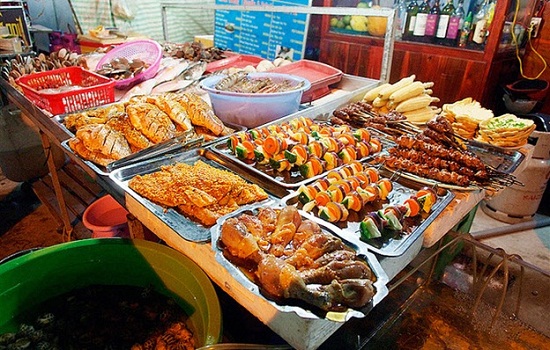
Coming to the marketplace, the first things people look to do are exchange goods and eat. Meanwhile, boys and girls scatter to the corners to play or sing. Many boys and girls make appointment on the next market day.

The Binh Lieu Highland Market, before day, it only took place on odd-numbered days of the third lunar month every year. Today, with better economic conditions for locals, the requirements for trade have seen the market open regularly every Sunday. It is open from 9:00 AM to 2:00 PM.

Before the market day, boys and girls choose the most beautiful costume for wearing as going to the market is a festive day and they can enjoy everything after a hard working day. It is also a chance for the boy conquers the girl's heart through singing to each other. Many young couples have also met on these busy Sundays, eventually become husband and wife.

Thứ Hai, 8 tháng 12, 2014

About Mekong Delta

Your trip to Sapa might be incomplete if you miss a trek to cultural villages which have attracted a lot of tourists nationwide by theirs unspoiled landscapes and traditional customs of ethnic minorities living here. Among many villages, ones introduced below are quite famous and worth paying a visit North Vietnam tours

Discover the authenic Mekong delta and cruise the river in comfort !

The Mekong Delta (Vietnamese: đồng bằng sông Cửu Long “Nine Dragon river delta”) is the region in southwestern Vietnam where the Mekong River approaches and empties into the sea through a network of distributaries. The Mekong delta tours region encompasses a large portion of southeastern Vietnam of 39,000 square kilometres (15,000 sq mi). The size of the area covered by water depends on the season.
As all deltas, it receives the bounty of the siltation from the upper Mekong, and as such is a very rich and lush area, covered with rice fields. It produces about half of the total of Vietnam's agricultural output (in fact the delta produces more rice than Korea and Japan altogether), and is the place for timeless sceneries of farmers planting or harvesting rice.
About Mekong Delta
About Mekong Delta


The Mekong splits in Cambodia into two main rivers, the Bassac (Hậu Giang) and the First river (Tiền Giang), then in Vietnam into a more complex system, creating a maze of small canals, rivers and arroyos interspersed with villages and floating markets.

Life in the Mekong Delta revolves much around the river, and all the villages are often accessible by river rather than by road.

The most renowned places in the Mekong Delta are Mỹ Tho and Caí Bè near Ho Chi Minh City, then, more to the heart of the region, Vĩnh Long, Sa Đéc, and Cần Thơ, from where it is possible to reach the remotest confines of the delta, South towards the mangroves and the East-sea, North towards Châu Đốc, or West towards the island of Phú Quốc.

Climate change concerns

Being a low-lying coastal region, the Mekong Delta is particularly susceptible to floods resulting from rises in sea level due to climate change. The Climate Change Research Institute at Can Tho University, in studying the possible consequences of climate change, has predicted that, besides suffering from drought brought on by seasonal decrease in rainfall, many provinces in the Mekong Delta will be flooded by the year 2030. The most serious cases are predicted to be the provinces of Ben Tre and Long An, of which 51% and 49%, respectively, are expected to be flooded if sea levels rise by 1 meter.

Economy

The region is famous as a large rice growing area. It produces about half of the total of Vietnam's rice output. Vietnam is the second largest exporter of rice globally after Thailand. In fact, the delta produces more rice than Korea and Japan altogether.

Additionally, the region is home to large aquacultural industry of basa fish, Tra catfish and shrimp, much of which is exported.

The Mekong Delta has recently been dubbed as a 'biological treasure trove'. Over 1,000 new species have been discovered in previously unexplored areas of Mekong Delta, including a species of rat thought to be extinct

Culture

Life in the Mekong Delta revolves much around the river, and many of the villages are often accessible by rivers and canals rather than by road.

The region is home to "cai luong", a form of Vietnamese folk opera.